Following are the main methods of irrigation,
- Surface Irrigation
- Free / Wild / Uncontrolled flooding method
- Border strip method
- Check method
- Basin method
- Furrow method
- Subsurface Irrigation
- Natural sub-surface irrigation method
- Artificial sub-surface irrigation method
- Micro irrigation
- Drip / Trickle Irrigation
- Sprinkler Irrigation
Surface Irrigation:
1. Free / Wild / Uncontrolled flooding method: It is oldest form of irrigation in which ditches are excavated in the filed, water from these ditches are allowed to flow across the filed without any restriction by opening the field regulators.

In this method cost of land preparation is low, but the main disadvantage of this method is that the water application efficiency is low.
2. Border strip method: This is the most popular method of flooding, In this method land is divided into a series of long, uniform graded, narrow strips separated by small bunds or low levees, these bunds guide the flow of water down the field.

Usually length of strips is in the range of 100 to 400 m whereas the width of strips are in the range of 10 to 20 m. Water is allowed to flow from supply ditch into each strip and during its travel water gets infiltrated into the soil. When the water reaches the lower end of strip, water supply to that strip is turned off.
3. Check method: In this method of flooding, agricultural area is divided into small plots by surrounding the area with low and flat levees, this levees act as check bunds and this check bunds are most of time constructed along the contours.

Water is supplied to the check basins through the filed channels which are connected with the supply channel. Water is retained in these check basins for sometimes to allow for infiltration into the soil. This method is suitable for both more permeable and less permeable soils, and mostly preferred for close growing crops such as paddy or jowar.
4. Basin method: In this method one or more trees are generally enclosed by circular, rectangular, square or any shape channel through which water flows and this circular, rectangular, square or any shape channel acts as a basin. This method is mainly used for watering orchards.

This method is most suitable for crops that are unaffected by standing water present over period of time.
5. Furrow method: In this method, water is supplied to the land by digging narrow channels at regular interval. These narrow channels are called furrow, water infiltrates through the wetted perimeter of the furrows and moves vertically and then laterally to saturated the soil.

usually crops are grown on the ridges between the furrows. Depth of the furrows varies from 8 to 30 cm while length of furrows are around 400 m. Method is preferred for flat area or gentle slope and suitable for crops like sugarcane, potato, tobacco etc.
Subsurface Irrigation :
1. Natural sub-surface irrigation method: Under favorable conditions of topography and soil conditions, the water table may be close enough to the root zone of the field of crops which gets its moisture due to the upward capillary movement of water from the water table. The natural presence of the water table may not be able to supply the requisite water throughout the crop growing season. However, it may be done artificially by constructing deep channels in the field which may be filled with water at all times to ensure the presence of water table at a desired elevation below the root zone depth.
2. Artificial sub-surface irrigation method: The concept of maintaining a suitable water table just below the root zone is obtained by providing perforated pipes laid in a network pattern below the soil surface at a desired depth. This method of irrigation will function only if the soil in the root zone has high horizontal permeability to permit free lateral movement of water and low vertical permeability to prevent deep percolation of water.
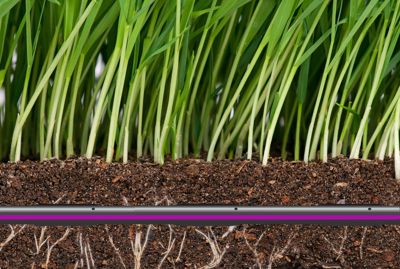
For uniform distribution of water percolating into the soil, the pipes are required to be very closely spaced, say at about 0.5m. Further, in order to avoid interference with cultivation the pipes have to be buried not less than about 0.4m below the ground surface. This method of irrigation is not very popular because of the high expenses involved, unsuitable distribution of subsurface moisture in may cases, and possibility of clogging of the perforation of the pipes.
Micro Irrigation:
1. Drip / Trickle Irrigation: Drip Irrigation system is sometimes called trickle irrigation and involves dripping water onto the soil at very low rates (2-20 litres per hour) from a system of small diameter plastic pipes filled with outlets called emitters or drippers.

Water is applied close to the plants so that only part of the soil in which the roots grow is wetted, unlike surface and sprinkler irrigation, which involves wetting the whole soil profile. With drip irrigation water, applications are more frequent than with other methods and this provides a very favourable high moisture level in the soil in which plants can flourish.
Sprinkler Irrigation: Sprinkler irrigation is a method of applying water which is similar to natural rainfall but spread uniformly over the land surface just when needed and at a rate less than the infiltration rate of the soil so as to avoid surface runoff from irrigation. This is achieved by distributing water through a system of pipes usually by pumping which is then sprayed into the air through sprinklers so that it breaks up into small water drops which fall to the ground.
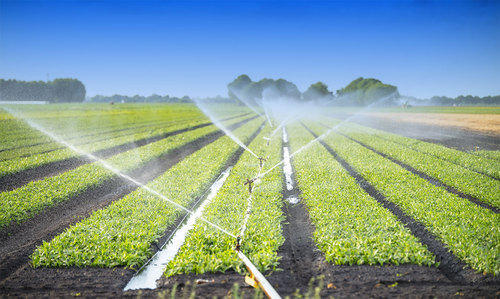
The system of irrigation is suitable for undulating lands, with poor water availability, sandy or shallow soils, or where uniform application of water is desired. No land leveling is required as with the surface irrigation methods. Sprinklers are, however, not suitable for soils which easily form a crust. The water that is pumped through the pump pipe sprinkler system must be free of suspended sediments. As otherwise there would be chances of blockage of the sprinkler nozzles.

No comments:
Post a Comment